Safe School Tech
The promise of tech in schools hasn’t turned out as we’d hoped.
Introducing technology into schools was supposed to improve learning, close the equity gap, and prepare students for careers in the tech era. How’s that going?
Not so well.
Learning. We were told that giving every student a laptop and the latest EdTech apps would improve learning. The results are in, and the opposite has happened. Immersing students in digital environments distracts students, fragments their attention, and reduces their ability to self-regulate. Test scores have gone down, not up.
Equity. We were told that giving every student a device would close the digital divide—that access would reduce inequality. Again, the opposite has happened. When screen time goes up and learning goes online, low-income kids’ reading and math scores go down the most. Neuroscientist Jared Cooney Horvath calls this the Equity Illusion of EdTech and has the data to back it.
Career Readiness. We were told that preparing students for future work requires “digital literacy skills.” It does. But instead of teaching students how to make good use of technology, we’ve taught them how to read, write, think, and do math using technology. Oops. And it turns out that the skills people need to work in the digital age—like reasoning, focus, and other mental muscles–are the very skills that Chromebooks, YouTube, and AI are eroding.
AAPS is quickly introducing technology that our kids aren’t ready for
First, it was issuing Chromebooks to every student starting in first grade. Then high schoolers got MacBook Airs. YouTube is a mainstay in lesson plans and accessible on school devices to kids too young to read or do arithmetic. (No, the filters aren’t working as promised).
Meanwhile, our kids are serving as guinea pigs for thousands of EdTech apps, many of them gamified and addictive. More platforms, apps, and devices are being added every year.
Most recently (April 2026), the district leadership proposed a massive rollout of AI at every level. It did this with great enthusiasm and optimism but little awareness of how this will affect our kids’ brains, bodies, learning, and mental health.
It doesn’t have to be this way.
In fact, it’s time to hit the pause button and ask each other and our school leaders a few simple questions:
What devices and content are appropriate at each grade level?
How do we weigh the benefits against the risks?
Is it fair to our kids to let them be guinea pigs for new untested technology?
If a family wants to opt-out, ask for accommodations, or simply weigh into decisions, how can it do this?
Parents are concerned, frustrated, and curious.
Many parents we've talked to are concerned. Some are frustrated, even angry. Most just want to understand what's actually happening, and whether anyone is asking the right questions before making decisions.
Technology has a place in schools, but we won’t let it run the show or own our kids’ futures. So, we're asking: What is it actually for? How much is too much? And who gets to weigh in on these questions?
“The business model of the technology industry, including EdTech, is fundamentally at odds with child development”
—Emily Emily Chernin, M.Ed., educator, author, and founder of The Screentime Consultant
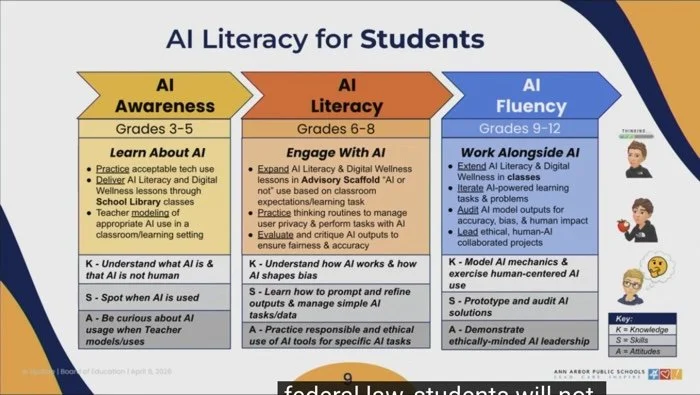
From AAPS Central Admin presentation of proposed AI rollout to school board on April 8, 2026
“We asked the superintendent's office if we could sign a waiver saying we don’t want a Chromebook next year and don’t want to do Lexia etc and understand that our daughter might fall behind and we take full responsibility to catch her up, but they said that’s not an option.”
- Former King Elementary family moving to private school
Attend a community conversation this spring with other parents at your school
In April and May, we will be holding community conversations in parents’ homes across the district. You’ll have a chance to share your experiences, concerns, and ideas with other parents at your child’s school. A professional facilitator will make sure the conversation is productive and everyone gets heard.
What are you experiencing?
We want to learn from you. What are you seeing in your child's classroom? What's working, what isn't, and what questions do you wish the district would ask before introducing more technology?
Your perspective matters.
We're gathering stories and concerns from families and teachers across AAPS before we decide what to ask for. This mapping of the terrain will help us learn who’s tried what and where we can the most tangible impact.
Would you be willing to tell us what you’re seeing?
Fast Facts
Nearly 90% of American public schools now provide children with internet-connected devices for learning.
Research shows students spend up to 40 out of 60 minutes off-task on school-issued laptops.
26% of teens aged 13 to 17 report using ChatGPT to do their schoolwork — on the very laptops their schools gave them.